

What Is Shilajit? Real Benefits, Safe Dosage & How to Avoid Fakes
- Home
- /
- Ayurvedic Herbs & Remedies
- /
- What Is Shilajit? Real...
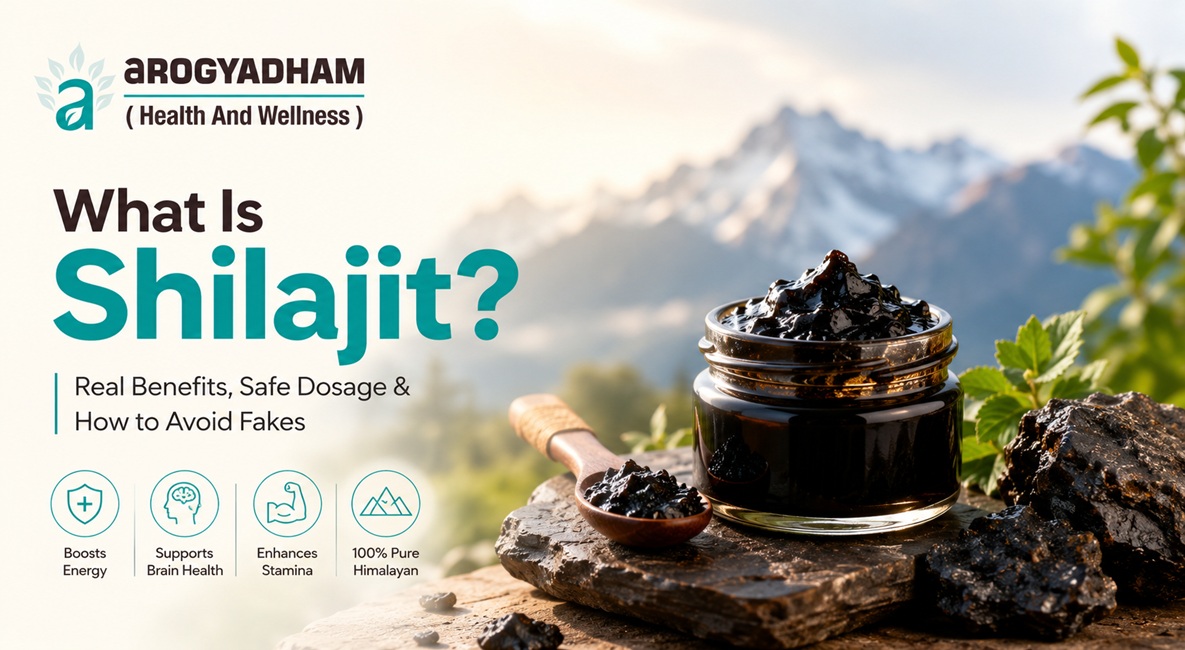
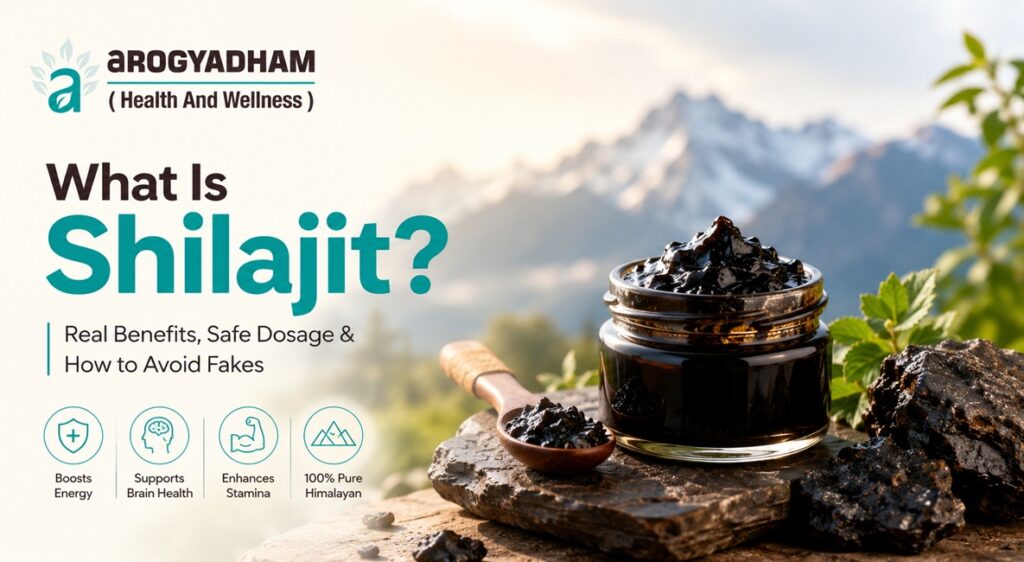
Shilajit is a dark, resin-like substance that oozes out of high-altitude rock in the Himalayas and a few other mountain ranges. It forms over centuries, as plant matter buried in rock layers slowly breaks down under pressure and heat. In Ayurveda, it’s called a rasayana, something used long-term to build strength, energy, and resilience rather than fix a problem overnight.
You’ve probably seen it pitched online as a testosterone hack you take once and feel by dinner. That’s not really how it works, and if a brand is telling you otherwise, that’s worth noticing. What the evidence and centuries of traditional use actually point to is something slower and less flashy: a mineral-dense adaptogen that does most of its work quietly, over weeks.
This guide walks through what’s actually in shilajit, what it’s used for, how much to take, and the part most articles skip: how to tell a real product from the fakes now flooding the market.
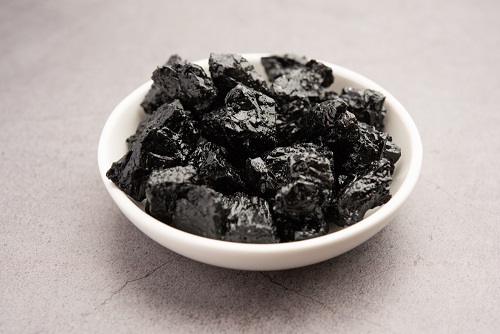
How Shilajit Actually Forms
Shilajit forms when plant matter gets trapped in mountain rock and is compressed over centuries by geological pressure and heat.
Here’s the longer version: as the Himalayas were still rising, plants and organic material got caught between shifting rock layers. Over an enormous stretch of time- we’re talking geological time, not decades- the weight of the mountains above, plus heat from deep in the earth, broke that plant matter down into a thick, mineral-rich substance. It slowly migrates upward through cracks in the rock and seeps out, most visibly in summer when heat expands the stone and pushes it to the surface.
So despite how it looks, shilajit has nothing to do with petroleum or tar in the industrial sense. It’s plant matter, slow-cooked by a mountain for a very long time.
What’s Actually in Shilajit?
Shilajit’s effects come down to four main components: fulvic acid, humic acid, trace minerals, and a small group of compounds called dibenzo-alpha-pyrones.
| Component | Typical Share in Purified Shilajit | What It’s Believed to Do |
|---|---|---|
| Fulvic acid | 15–60% (premium extracts often standardized to 20–50%) | Antioxidant; may help transport nutrients into cells |
| Humic acid | 10–20% | Gives shilajit its dark color; linked to antioxidant and anti-inflammatory activity in early studies |
| Dibenzo-alpha-pyrones (DBPs) | Under 1%, trace amounts | Early research connects these to mitochondrial (cellular energy) support |
| Trace minerals (iron, zinc, magnesium, copper, potassium) | 20–40% combined | Involved in normal energy metabolism, muscle function, and immune activity |
Composition swings a fair amount depending on where the shilajit was sourced and how it was purified — which is really the whole reason lab testing matters more than the marketing copy on the label. More on that further down.
What Shilajit Is Traditionally Used For?
Worth being straight about this upfront: most of what’s below reflects traditional Ayurvedic use and early-stage research, not settled clinical proof. Read it as “here’s why people take it,” not a list of guarantees.
- Energy that builds instead of spikes: Shilajit doesn’t behave like caffeine. It’s linked to mitochondrial function — the energy-producing part of your cells — so the effect tends to show up as steadier stamina over a day rather than a jolt. Most people say they notice something in the first couple of weeks, with the more consistent effect showing up after a month or two.
- Hormonal support, for men and women differently: In men, it’s traditionally tied to testosterone levels, sperm health, and general vitality with age. In women, it’s used more for smoothing out energy dips across the menstrual cycle and supporting overall hormonal balance. Neither use case is a guarantee — individual response varies a lot here.
- Recovery after training: Active people use it to help the body bounce back after hard workouts, supporting muscle strength retention and cutting down that wiped-out feeling the next day.
- Libido and general sexual wellness: Separate from the hormone angle specifically, shilajit has a long traditional reputation as a libido tonic for both men and women, tied more to stamina and confidence than a specific number on a lab test.
- Getting nutrients where they need to go: Fulvic acid is thought to act like a delivery mechanism, helping shuttle vitamins and minerals into cells more efficiently. It’s part of why people often stack it with other supplements — the idea being your body actually uses what you’re taking, instead of it passing through.
- Mental clarity: Traditionally linked to memory support, and increasingly studied for cognitive benefits. Most users describe it as less brain fog rather than a dramatic sharpening.
- Bone and joint support over time: The mineral density plus fulvic acid’s antioxidant activity is traditionally associated with slowing age-related bone density loss. This is a long-game use, not something for acute joint pain.
- Healthy iron levels: Shilajit naturally contains iron and has traditional use supporting hemoglobin levels alongside a normal diet — which is also exactly why it’s not right for people with iron-overload conditions (see the caution list below).
- Cellular “housekeeping: The flip side of nutrient delivery — fulvic acid is also thought to help the body clear out cellular waste, supporting general cell efficiency over time.
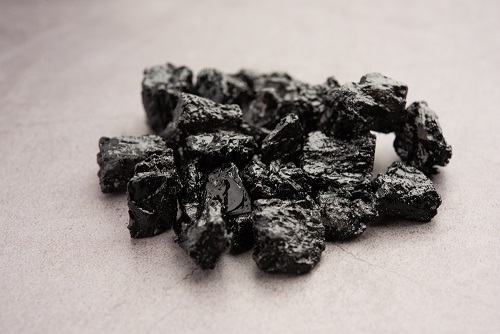
The Different Forms of Shilajit — and How Each Is Made
- Resin — scraped from rock, then purified through low-heat water extraction to remove impurities and concentrate it.
- Powder — purified resin or extract, dehydrated (usually spray-dried or freeze-dried) and milled fine.
- Capsules/tablets — powder encapsulated in a gel or plant-based shell, or pressed into tablets with binders.
- Gummies — extract blended into a heated gelatin or pectin base with sweeteners, then set.
- Sticks/sachets — resin portioned into single-use doses, sometimes with honey or another traditional carrier.
Resin is generally considered the least processed and most potent form. Capsules trade a bit of that for convenience.
How Much Shilajit Should You Take?
Most healthy adults use somewhere between 300–500mg of purified shilajit per day, after starting with a smaller dose to check tolerance.
- Week one: start with a grain-of-rice-sized amount of resin (or the equivalent in your chosen form) to let your body adjust and lower the odds of stomach upset.
- After that: most people settle into 300–500mg daily, with many finding the lower end of that range enough for regular maintenance use.
- Timing: the most common approach is taking it in the morning, 30–60 minutes before breakfast, when absorption is generally considered best. If you’re using it mainly for workout recovery, taking it around your training session instead is common too.
How to take each form:
- Resin — dissolve a pea-sized amount in warm (not boiling) water, milk, or tea. High heat degrades the active compounds, so keep it warm, not hot.
- Powder — stir into water, milk, a smoothie, or yogurt.
- Capsules/tablets — swallow with water.
- Gummies — chew as directed.
If you’re pregnant, breastfeeding, on regular medication, or managing a chronic condition, talk to your doctor before you start — not after something feels off.
Possible Side Effects
Properly purified, lab-tested shilajit is well tolerated by most people, but side effects can include stomach upset, dizziness, a faster heartbeat, mild skin irritation, or headache — usually at higher doses or on an empty stomach.
Who Should Be Extra Cautious
- Pregnant or breastfeeding women
- Children
- Anyone with hemochromatosis, sickle cell anemia, or thalassemia (because of the iron content)
- People with gout or high uric acid
- Anyone with kidney or liver conditions
- Anyone on blood pressure, blood sugar, or thyroid medication — shilajit may interact with these
Also Read: The Ayurveda Benefits- A Secret To Health Benefits
Shilajit Myths, Fact-Checked
“It works instantly, like an energy drink.” No — it’s an adaptogen, not a stimulant. Expect gradual changes over weeks, not minutes.
“It’s only for men.” Not true. Women have used it traditionally for iron support, bone density, and hormonal balance for just as long.
“Raw, unprocessed shilajit is the purest form.” Actually the opposite — raw shilajit straight off the rock can carry heavy metals, dirt, and microbial contamination. Purified and lab-tested is the version worth using.
“It can replace prescription treatments.” It’s not a fast-acting drug and isn’t a substitute for medical care. It supports things gradually, not on demand.
“It’s too heating for summer.” At a sensible dose (300–500mg/day), it’s generally considered fine year-round.
When Should You Consult an Ayurvedic Doctor?
While Shilajit is a well-known Ayurvedic Rasayana, it is not suitable for everyone or every health condition. The right dosage, duration, and combination of herbs depend on your body constitution (Prakriti), age, digestive strength, and underlying health concerns. Self-medicating with Shilajit may not provide the desired results and, in some cases, may not be appropriate.
At Arogyadham Health & Wellness, our experienced Ayurvedic doctors evaluate your health holistically before recommending Shilajit or any other Ayurvedic medicine. We create personalized Ayurvedic treatment plans that may include herbal medicines, Panchakarma therapies, dietary guidance, and lifestyle recommendations to address the root cause of your health concerns.
How to Avoid Fake Shilajit
The category’s popularity means the market is now full of knockoffs. Before buying, check for:
- A Certificate of Analysis (COA). Real brands share third-party lab results confirming testing for heavy metals and microbial contamination — ask for it if it’s not posted.
- A short, clean ingredient list. Mostly (or entirely) purified shilajit. Long filler or sweetener lists are a flag, unless it’s clearly sold as a blend.
- A seller you actually trust. Buy direct from the brand or a retailer with a track record — it cuts your odds of getting a counterfeit.
- Realistic claims. Disease cures, overnight testosterone spikes, guaranteed results — these are red flags, not selling points.
- A price that makes sense. Purified, tested shilajit costs money to produce. If it’s suspiciously cheap, something’s probably being cut.
Also Read: पेट की चर्बी कम करने के आयुर्वेदिक उपाय
Bottom Line
Shilajit is potent, and that’s exactly why it isn’t something to self-prescribe based on a blog post or a product label. The right dose, the right form, and whether it even suits your body depends on things only a proper assessment can tell you.
At Arogyadham Health, that’s how we approach it — our Ayurvedic practitioners look at your health history and what you’re actually trying to fix before shilajit ever enters the picture. If you’re curious whether it’s right for you, that conversation is the real starting point, not a bottle bought online.
Frequently Asked Questions
Does shilajit look like tar because it is tar?
No. It just resembles tar visually — it’s actually formed from plant matter and minerals, with no connection to petroleum or asphalt.
How long before I notice effects?
Usually 2–8 weeks of regular use. It builds gradually rather than hitting all at once.
Can women take shilajit?
Yes, and they’ve used it traditionally for just as long — mainly for iron support, energy, and hormonal balance. Skip it if pregnant, breastfeeding, or managing a blood condition, and check with a doctor first.
Does shilajit taste bad?
Most people find it earthy and bitter, especially the first few times. Mixing it into warm milk or tea helps a lot.
Does it actually raise testosterone?
It may support healthy hormone levels over time in some people, but it’s not a guaranteed or instant effect. Be skeptical of any brand claiming otherwise.
What’s the difference between resin, powder, and capsules?
Same substance in different forms. Resin is the least processed and often considered most potent. Powder is dehydrated resin. Capsules are powder in a shell, built for convenience.
- What Is Thyroid? Symptoms, Causes, Tests and Ayurvedic Treatment Explained

- Urinary Tract Infection (UTI): Symptoms, Causes, Treatment & Why UTIs Keep Coming Back

- What Is Shilajit? Real Benefits, Safe Dosage & How to Avoid Fakes
- पेट की चर्बी कम करने के आयुर्वेदिक उपाय

- Moringa vs Multivitamin – Which Is Best for Your Health?
Ready to Heal Naturally?


Share With
Friends

Dr. Rakesh Agarwal, a third-generation Ayurveda expert and research scholar, treats chronic ailments through Ayurveda and Panchakarma. He is also the founder-editor of Arogyadham Magazine, promoting Ayurveda and wellness to over a million readers since 1992.






Dr. Arjun Raj, an Ayurvedic physician and wellness expert, is the Director of Arogyadham Health Care and serves on the executive board of Arogyadham Health and Wellness. He blends traditional Ayurveda with modern wellness to promote balanced, healthy living.

Dr. Amrit Raj, an Ayurvedic doctor and certified yoga teacher, is the Director of Arogyadham Health and Wellness. He specializes in chronic conditions and actively promotes Ayurveda and yoga worldwide for healthier living.